One part of my quotidian life that I enjoy very much is the occasional moment of "ordinary grace," or "backyard magic." The times when the regular ol' day is unrolling, and somehow, a window opens into the numinous. It can occur at any time, around any activity. Sheer grace.
So, the other day, the older children and I were in the back yard (in a rare moment of sunshine), gardening and puttering, respectively. A sound finally registered in my addled brain -- a deep humming. At the same time, Thing 3 said, "Mama! a bee that can't fly!" We picked it up on a stick, and it was fine, just walking around. What it also was was much larger than most bees. A drone. A thought began forming in my brain. When I looked up, I saw something I've never seen before -- a cloud, an absolute cloud, of bees pouring out of the hive in the neighbor's walnut tree.

I had been very excited when we had noticed that first hive, as we've put in a number of fruit trees and as everyone learns when they're children, bees help pollinate fruits and vegetables. Good insects!
So I looked up and saw something like this:

We were in a mass of bees. They flew in the air, they flew in circles around our yard, they landed on us, got caught in our hair, and no one got stung. We just brushed them off and they went about their very important business. Swarming, on the first bright day in weeks.
In about ten minutes, the hum changed as their flight pattern began to alter -- from a cloud to a vortex. A vortex centered on a different tree. Just look at this golden beauty in front of the group:
 We were entranced, and spent a lot of time looking at them through "finoculars" and saying wise things like, "Ooooooooh," and "Wow." After some time, they assumed their final configuration:
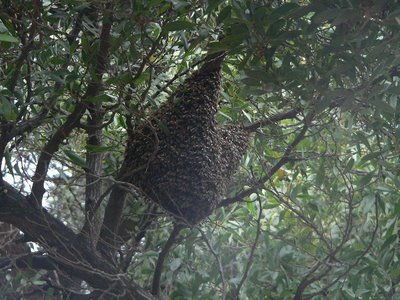
Although the apiarist I spoke with said that the new queen would move the hive in a couple of days, I sort of hope they work it out to stay there. As I said, I like the bees. And besides, they're magical. Maybe I'm going to have to furnish some sort of hive box, up high on a pole. I don't want to keep bees, I just want to have bees, for themselves. I also don't know if the old hive is stll viable, and they just swarmed because it was getting crowded, or if the original queen died.
I tend to go on and on, don't I? Meanwhile, I finished this:
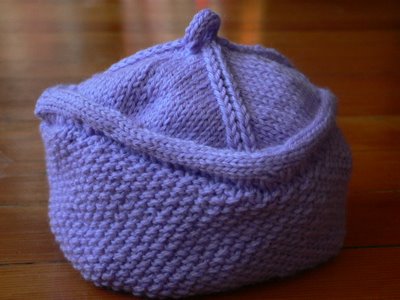
It's the second iteration, as I messed up the decreases on the first one. Here's the "free pattern," although I bet anyone could work it out by looking at it:
Easter "Bonnet" Pattern for a Chilly Baby
Yarn: Knitpicks Merino Style -- It uses less than a single 50gm skein
Gauge: 5 sts/in, 1.75/cm in seed stitch
Needles: Circular or double-pointed in whatever size you need for gauge (I used a US 6)
Cast on 81 stitches.
Place marker at beginning of round. Knit in seed stitch (k1, p1 to end of round, ending with a k1, begin next round p1, k1, continue.
When brim is as tall as you want, k1, kf&b around entire round. I wanted a tall look, so mine's about 3"/7 3/4 cm.
With second needle, I went up a size, cast on 5 stitches, toward the "inside" of the hat. Using another needle, make i-cord and pick up a stitch from the original needle and knit it together with the 5th stitch each time -k4, K2tog, slide to the other end of the needle, pull yarn around and repeat. This attaches the i-cord to the top edge of the hat. At the end of the i-cord round, break yarn and sew the live stitches from the last needle to the cast-on part of the i-cord.
Using whatever size needle makes you happy -- I stayed with the larger one -- pick up stitches on the inside of the i-cord or the top of the brim all around. Make it a multiple of however many decreases you want. I wanted three, so I ended up picking up 120.
Place markers evenly around the picked-up stitches, and k every round, k2tog before each marker and ssk after each. Decrease on every round. Fewer stitches would have made a flatter brim, and that's a look I wanted, but I'm not going to redo it this time.
At the end of your decrease rounds, when there are between 6-4 stitches left, switch to making i-cord again, for just a few rounds. Break yarn, draw end of yarn through the remaining stitches on the needle, pull it through the hat, and secure, tightening up any little holes.
That's it! Here is is on the intended wearer:

Now I'm going to see if I can pull a Rain and knit a matching top-down, swingy, seed-stitch bordered raglan sweater to match. By Sunday. Thing 4's Easter dress is really thin. Wish me luck!
 We were entranced, and spent a lot of time looking at them through "finoculars" and saying wise things like, "Ooooooooh," and "Wow." After some time, they assumed their final configuration:

Although the apiarist I spoke with said that the new queen would move the hive in a couple of days, I sort of hope they work it out to stay there. As I said, I like the bees. And besides, they're magical. Maybe I'm going to have to furnish some sort of hive box, up high on a pole. I don't want to keep bees, I just want to have bees, for themselves. I also don't know if the old hive is stll viable, and they just swarmed because it was getting crowded, or if the original queen died.
I tend to go on and on, don't I? Meanwhile, I finished this:

It's the second iteration, as I messed up the decreases on the first one. Here's the "free pattern," although I bet anyone could work it out by looking at it:
Easter "Bonnet" Pattern for a Chilly Baby
Yarn: Knitpicks Merino Style -- It uses less than a single 50gm skein
Gauge: 5 sts/in, 1.75/cm in seed stitch
Needles: Circular or double-pointed in whatever size you need for gauge (I used a US 6)
Cast on 81 stitches.
Place marker at beginning of round. Knit in seed stitch (k1, p1 to end of round, ending with a k1, begin next round p1, k1, continue.
When brim is as tall as you want, k1, kf&b around entire round. I wanted a tall look, so mine's about 3"/7 3/4 cm.
With second needle, I went up a size, cast on 5 stitches, toward the "inside" of the hat. Using another needle, make i-cord and pick up a stitch from the original needle and knit it together with the 5th stitch each time -k4, K2tog, slide to the other end of the needle, pull yarn around and repeat. This attaches the i-cord to the top edge of the hat. At the end of the i-cord round, break yarn and sew the live stitches from the last needle to the cast-on part of the i-cord.
Using whatever size needle makes you happy -- I stayed with the larger one -- pick up stitches on the inside of the i-cord or the top of the brim all around. Make it a multiple of however many decreases you want. I wanted three, so I ended up picking up 120.
Place markers evenly around the picked-up stitches, and k every round, k2tog before each marker and ssk after each. Decrease on every round. Fewer stitches would have made a flatter brim, and that's a look I wanted, but I'm not going to redo it this time.
At the end of your decrease rounds, when there are between 6-4 stitches left, switch to making i-cord again, for just a few rounds. Break yarn, draw end of yarn through the remaining stitches on the needle, pull it through the hat, and secure, tightening up any little holes.
That's it! Here is is on the intended wearer:

Now I'm going to see if I can pull a Rain and knit a matching top-down, swingy, seed-stitch bordered raglan sweater to match. By Sunday. Thing 4's Easter dress is really thin. Wish me luck!


