Last week, I noticed some bean leaves appeared to have been sprayed with metallic paint. At least, that's the first thing that popped into my head. They looked a little like these bronzed leaves:
And here are some unhappy looking pole bean leaves.
After doing some research, I fear that it's mosaic virus, because they're primarily saved seeds. But maybe it's a nutritional deficiency? Who knows? I'm such a lackadaisical gardener that it could be almost anything.
But all is not grim, disease-and-fungus-related news here at this Sicilian Sister's house. Look! Baby baby cucumbers. These are the kind that Trader Joe's sells in little boxes for lots of money. They make excellent snacks, being fully ripe at about five inches.
And this year's experiment: black popcorn. I've seen many tassels, but not much flying pollen, so I'm just at the finger-crossing state.
And finally, what do you think the plural noun should be for summer squash? An enthusiasm? An overwhelm? Pick 'em young, at any rate!
Showing posts with label disease. Show all posts
Monday, June 18, 2012
Saturday, June 16, 2012
Low-down, dirty rotten. . .
I had put off a chore until today -- it wasn't the garden's fault that it was really hot when I finally got to it.
The blight or virus or wilt or whatever had gotten worse in the tomatoes, and I was going to do a thorough removal of all affected foilage in hopes of slowing down its advance.
The plants are bushy and compact -- it was challenging getting under there to pull off the branches, but there were some compensations. Look! Baby tomatoes. If I get this stuff under control, maybe there will be some for sauce.
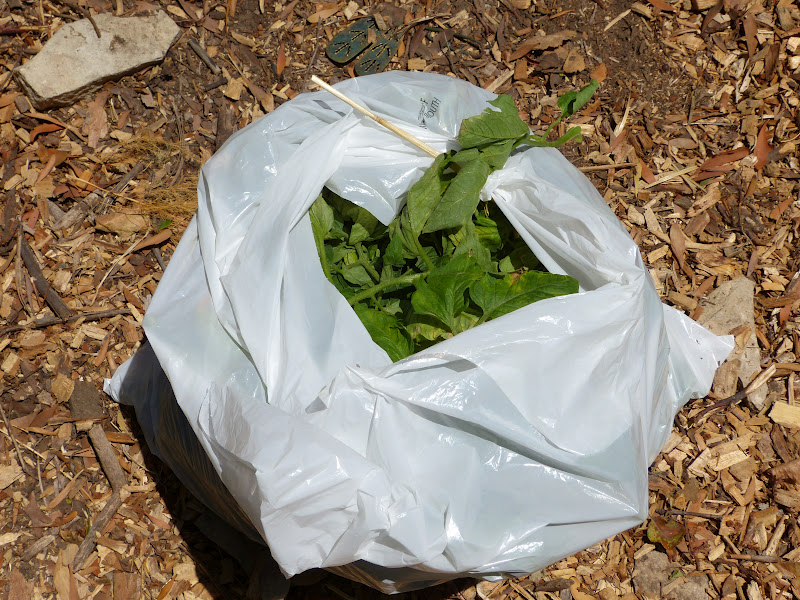
It took me two shifts, one in the afternoon and one in the evening, to work both sides of the long bed. What was once a dense tomato hedge is now a slightly less-dense tomato hedge. I ended up with a full trash bag of diseased plant tissue. That got put in the landfill bin, not the municipal compost, because I don't want to spread it around any more.
While I was looking down anyhow, I spotted a pretty vigorous invasion of Bermuda grass along the fence. That bed will need weed barrier if it's going to go perennial asparagus any time soon.
Perhaps tomorrow will feature "Bean Mosaic Virus or Sunburn: You Decide" for entertainment. There's never a dull day in the garden. Discouraging, hot, hard work, yes, but not dull. Thank goodness.
The blight or virus or wilt or whatever had gotten worse in the tomatoes, and I was going to do a thorough removal of all affected foilage in hopes of slowing down its advance.
The plants are bushy and compact -- it was challenging getting under there to pull off the branches, but there were some compensations. Look! Baby tomatoes. If I get this stuff under control, maybe there will be some for sauce.
It took me two shifts, one in the afternoon and one in the evening, to work both sides of the long bed. What was once a dense tomato hedge is now a slightly less-dense tomato hedge. I ended up with a full trash bag of diseased plant tissue. That got put in the landfill bin, not the municipal compost, because I don't want to spread it around any more.
While I was looking down anyhow, I spotted a pretty vigorous invasion of Bermuda grass along the fence. That bed will need weed barrier if it's going to go perennial asparagus any time soon.
Perhaps tomorrow will feature "Bean Mosaic Virus or Sunburn: You Decide" for entertainment. There's never a dull day in the garden. Discouraging, hot, hard work, yes, but not dull. Thank goodness.
Monday, June 15, 2009
Nooooo!
If I could grow just one thing in my garden, it would be tomatoes: heavy, deep-red Early Girls, with Sungolds a close second.
Most of my Early Girls are thriving, threatening to grow taller than I.
My Sweet 100s, a couple Sungolds, and even one of my bush Early Girls, on the other hand, are beginning to look like this:

Stefani suggested it might be late blight; I think it's early blight, but the fact is it's blight. My tomatoes are blighted. They've been smote.

What I've been able to learn about early blight so far suggests it's a root issue; helpful phrases like "sterilize your soil" come up. Great.
The edamame are also struggling, though I think it's something else.

I believe a tiny pest caused these to look like brown-spotted lace, and I know slugs did the rest. I'm just waiting to see whether we'll get a small crop before they become compost.
Not all is gloom and doom, though. The broccoli, kale, potatoes, corn, and squash are thriving; the wax beans are large and lovely, sweet and tender enough to eat fresh off the bush.

And the happiest garden treat of all popped up all on its surprising own:

An honest to goodness morel, one of the most prized edibles out there, growing among the corn. We've been regaled with (Internet) tales from our fellow local mushroom hunters, lucky folks returning from the mountains with sacks full of giant morels. We've considered making the 3-hour drive ourselves, and now looky there!
The garden, she taketh away and she giveth.
Most of my Early Girls are thriving, threatening to grow taller than I.
My Sweet 100s, a couple Sungolds, and even one of my bush Early Girls, on the other hand, are beginning to look like this:
Stefani suggested it might be late blight; I think it's early blight, but the fact is it's blight. My tomatoes are blighted. They've been smote.
What I've been able to learn about early blight so far suggests it's a root issue; helpful phrases like "sterilize your soil" come up. Great.
The edamame are also struggling, though I think it's something else.
I believe a tiny pest caused these to look like brown-spotted lace, and I know slugs did the rest. I'm just waiting to see whether we'll get a small crop before they become compost.
Not all is gloom and doom, though. The broccoli, kale, potatoes, corn, and squash are thriving; the wax beans are large and lovely, sweet and tender enough to eat fresh off the bush.
And the happiest garden treat of all popped up all on its surprising own:
An honest to goodness morel, one of the most prized edibles out there, growing among the corn. We've been regaled with (Internet) tales from our fellow local mushroom hunters, lucky folks returning from the mountains with sacks full of giant morels. We've considered making the 3-hour drive ourselves, and now looky there!
The garden, she taketh away and she giveth.
Saturday, June 13, 2009
"Fireblight"
That's what the nurseryman said he thought it was.

If you're familiar with the disease, you know it's devastating to orchards, and nothing to sniff at at home, either.

So, although I wasn't thrilled about it, I did the necessary cutting. I usually like pruning, figuring that everything can grow back, anyhow, but these were expensive pre-done espaliers, and their graceful forms cheer me. One branch out of eighteen was already broken, and I figure that if things keep on as they have been, I'm going to get some experience grafting.

I kept telling myself that, anyhow. And the (thinned) fruit was mostly on healthy branches, so we may still get a crop this year.
And -- hygiene. I know the rules. I just don't always follow them, figuring again, that everything will be fine. It's not always, though, so a 10% bleach solution before and after every cut.

The material also went straight into the landfill, not even into the municipal green waste. I don't want to spread this around.

One branch was bad about 80% of the way to the main trunk. We could see the difference in the wood, and cut until the cross section was healthy.

Now I'm wondering if I should have painted all the cuts with bleach. Please don't tell me if it's too late to do anything about it. The nurseryman also promised copper if a hard pruning and deep watering didn't turn them around.
My fingers (and pruning shears) are crossed.
If you're familiar with the disease, you know it's devastating to orchards, and nothing to sniff at at home, either.
So, although I wasn't thrilled about it, I did the necessary cutting. I usually like pruning, figuring that everything can grow back, anyhow, but these were expensive pre-done espaliers, and their graceful forms cheer me. One branch out of eighteen was already broken, and I figure that if things keep on as they have been, I'm going to get some experience grafting.
I kept telling myself that, anyhow. And the (thinned) fruit was mostly on healthy branches, so we may still get a crop this year.
And -- hygiene. I know the rules. I just don't always follow them, figuring again, that everything will be fine. It's not always, though, so a 10% bleach solution before and after every cut.
The material also went straight into the landfill, not even into the municipal green waste. I don't want to spread this around.
One branch was bad about 80% of the way to the main trunk. We could see the difference in the wood, and cut until the cross section was healthy.
Now I'm wondering if I should have painted all the cuts with bleach. Please don't tell me if it's too late to do anything about it. The nurseryman also promised copper if a hard pruning and deep watering didn't turn them around.
My fingers (and pruning shears) are crossed.
Subscribe to:
Posts (Atom)